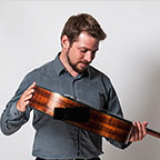
Maxim Vengerov

Vengerov was born on 20 August 1974 in Novosibirsk, to a family with a strong musical tradition. His mother sang and conducted a 500 voice orchestra, and his father played first oboe in the local philharmonic. At age five, he began studying the violin with Galina Tourchaninova, and five years later, with Zakhar Bron. 1984 saw the child prodigy at age 10 go abroad touring for the first time. In Lublin, Poland, he won first place at the International Karol Lipiński and Henryk Wieniawski Young Violin Player Competition. When Bron left Russia in 1987 to teach at the Royal Academy of Music in London, Vengerov and his mother followed him there, and did so again after Bron moved to Lübeck to open a school there. He subsequently immigrated to Israel, where he served in the Israel Defense Forces.
In 1990, Vengerov won the International Carl Flesch Competition in London. His public appearances – both solo and with orchestras – at major European music events sparked the interest of major record labels (to date, he has recorded close to 100 compositions or cycles) and music magazines. Numerous recording prizes and "Artist of the Year" titles (including one from Gramophone) followed, as did a Grammy Award, Edison Award(for the recording of Shostakovich Second Concerto), and the "Echo Klassik" annual distinction awarded to him by the German Television in 2003 for a recital featuring works by J. S. Bach).
In 1997, he became UNICEF's Envoy for Music and has met and performed for children in such places, as Uganda, Thailand and Kosovo. Playing by Heart, an American television production (on NBC), about the artist's meetings with young musicians during his master classes, was shown at the Cannes Festival in 1999. Contacts with Mstislav Rostropovich, Daniel Barenboim and Vag Papian, as well as performances with the world's most famous orchestras, like the Amsterdam Concertgebouw Orchestra, the BBC Philharmonic and the Chicago Symphony, added to Vengerov's artistic progress. The artist took a two-year course in the Baroque violin repertoire of the epoch. However, he does not restrict himself to the violin; the viola, jazz improvisation, dance, and conducting have also drawn his attention. Since the earliest stages of his career, he has been playing various Stradivari instruments; at present, it is the 1727 "Ex-Kreutzer".
You have to be a member to access this content.
Please login and subscribe to a plan if you have not done so.
When you subscribe to the blog, we will send you an e-mail when there are new updates on the site so you wouldn't miss them.